

There is a version of India that does not belong to postcards or peak-season itineraries.
It arrives quietly with the first heavy rains between June and September, when the skies open, the dust dissolves, and the entire country exhales into green.
The monsoon is not just a change in weather. It is a transformation of mood, landscape, and rhythm. Mountains blur into mist. Rivers swell with new life. Waterfalls appear where none existed before. And forests which were long dry and waiting become almost luminous.
For those willing to travel through rain rather than avoid it, India becomes something entirely different: softer, wilder, and more deeply alive.
Here are some of the most unforgettable monsoon destinations across India.
Valley of Flowers, Uttarakhand: Where the Himalayas Bloom for a Brief Moment
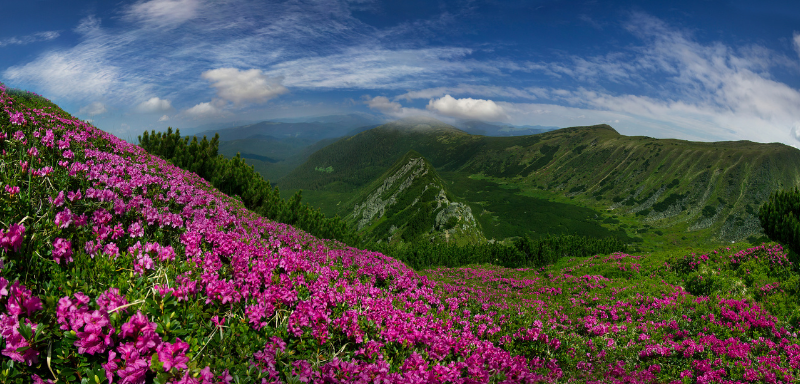
Hidden deep within the high-altitude folds of the Himalayas lies Valley of Flowers National Park, a place so delicate and so brief in its beauty that it almost feels unreal.
Reaching it is not simple. The journey begins at Govindghat and continues with a long, steady trek through rain-fed forests, wooden bridges, and cloud-laced valleys. As altitude increases, the world begins to quiet down until even sound feels softened by mist.
And then, suddenly, the valley opens.
What appears is not a single view but an overwhelming canvas: over 600 species of alpine flowers spread across vast meadows. Blue poppies, Himalayan bellflowers, cobra lilies, and the rare brahmakamal bloom in layered waves of color. Between mid-July and August, the entire valley becomes a living painting.
The beauty here is not just in what you see but in what you know you are witnessing: something temporary, fragile, and impossibly perfect.
Cherrapunji (Sohra), Meghalaya: Living Inside the Clouds
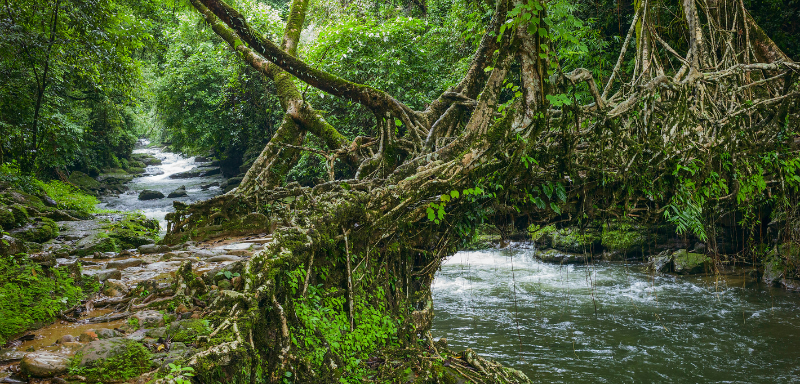
In the East Khasi Hills of Meghalaya sits Cherrapunji (Sohra), a place where rain is not occasional but constant, shaping everything it touches.
Here, the monsoon does not arrive. It never leaves.
Waterfalls like Nohkalikai crash down cliffs with a force that feels ancient. Entire valleys disappear into low-hanging clouds that drift through villages like slow-moving spirits. Roads glisten endlessly under rainwater, and every surface carries the sound of dripping, flowing, or rushing water.
But what makes Sohra unforgettable is not just its rainfall, it is how life adapts to it.
Nearby villages such as Nongriat are home to the famous living root bridges, grown patiently over decades from the roots of rubber fig trees. These bridges do not just survive the rain, they thrive in it, becoming stronger with time.
Standing here, it feels as if nature is not a backdrop but the architect of everything.
Munnar, Kerala: Tea Gardens Floating in Mist
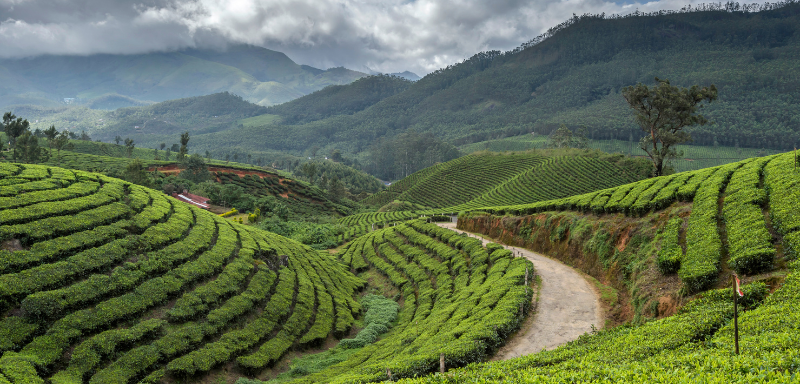
High in the Western Ghats, Munnar transforms into something almost dreamlike when the monsoon arrives.
Tea plantations stretch endlessly over rolling hills, their neat rows softened by drifting fog. The air carries the smell of wet earth and fresh tea leaves. Roads disappear into mist and reappear just as quickly, like scenes in a slow-moving film.
Waterfalls such as Attukal and Lakkam swell into roaring streams, carving silver lines through dense green valleys. Even time feels slower here, you find yourself pausing not because you have to, but because the landscape demands attention.
Munnar in monsoon is not about sightseeing. It is about being inside the landscape itself.
Coorg, Karnataka: Rain, Coffee, and Endless Green Silence
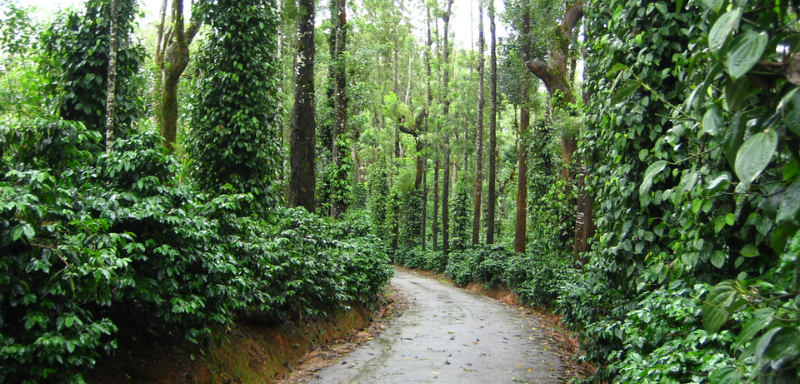
Known as the “Scotland of India,” Coorg (Kodagu) becomes even more atmospheric during the rains.
The Western Ghats wrap the region in dense green layers. Coffee estates glisten under steady drizzle, their leaves heavy with moisture. The sound of rain hitting leaves, rooftops, and forest floor becomes a constant rhythm.
At Abbey Falls, water does not simply fall, it erupts. The river gathers monsoon strength and plunges into a roaring cascade surrounded by thick jungle.
Coorg is not loud or flashy in its beauty. It is slow, rich, and deeply grounding, the kind of place where you remember what silence sounds like.
Agumbe, Karnataka: A Rainforest That Never Stops Breathing
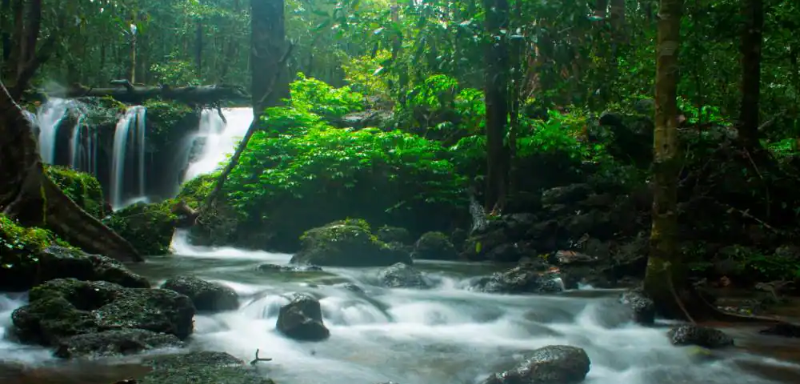
Deep within the Shivamogga district lies Agumbe, one of the wettest and most biologically rich regions in India.
The rainforest here feels ancient and alive in a very immediate way. Every surface is wet. Every sound is amplified. Frogs call through the night, insects hum continuously, and rain arrives in waves so dense it feels like fog turned liquid.
Agumbe is also home to the king cobra and the Agumbe Rainforest Research Station, where scientists study one of the last remaining lowland rainforests of the Western Ghats.
And then, when the rain briefly pauses, the sky opens just enough to reveal one of India’s most dramatic sunsets with gold spilling over endless green, before the clouds close again.
Kaas Plateau, Maharashtra: A Short-Lived Floral Universe
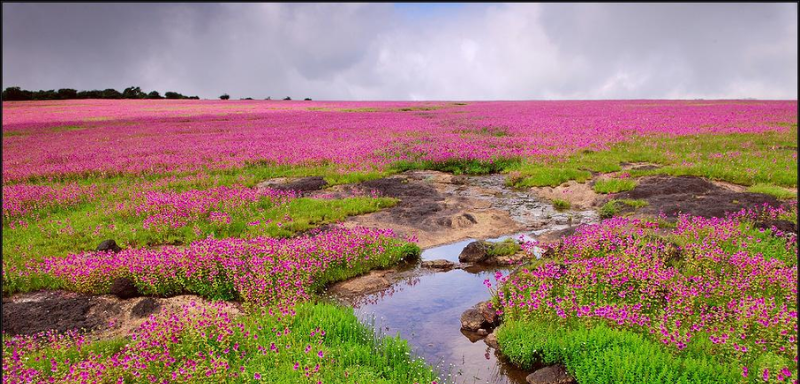
Every year after the peak monsoon, Kaas Plateau undergoes a transformation so delicate it feels almost unreal.
The basalt rock plateau near Satara suddenly erupts into color, tiny endemic flowers carpeting the ground in shades of pink, purple, yellow, and white. Species like Smithia, Utricularia, and hundreds of others bloom simultaneously, turning the landscape into a natural mosaic.
The experience is tightly regulated to preserve this fragile ecosystem, meaning visits are limited and carefully managed.
What you get in return is not just beauty, but rarity, the feeling of witnessing something that exists only for a few weeks each year and nowhere else on earth in quite the same way.
Amboli, Maharashtra: Hidden Waterfalls and Rainforest Wilderness
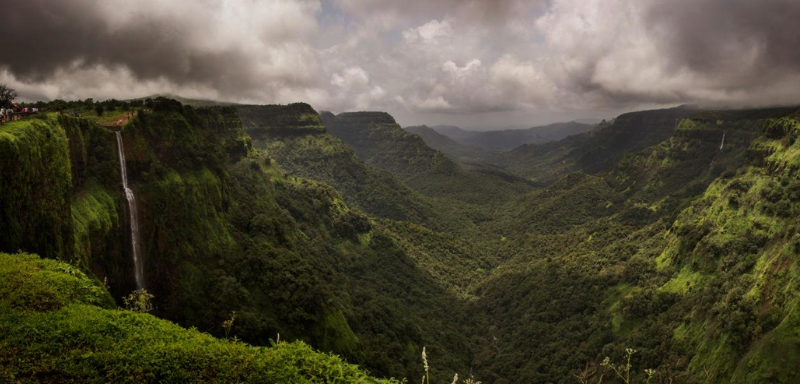
At the southern edge of Maharashtra’s Western Ghats lies Amboli, a place that feels like it belongs to a different rhythm of nature.
Waterfalls appear suddenly along winding roads, often without warning. Forest floors come alive with amphibians, especially frogs that emerge in extraordinary variety during the rains. The entire region becomes a living laboratory of monsoon ecology.
The Hiranyakeshi River begins its journey here, born directly from rain-fed hills and underground springs.
Amboli is not polished or curated. It is raw, humid, and alive in a way few places still are.
Wayanad, Kerala: Ancient History Wrapped in Green Rain
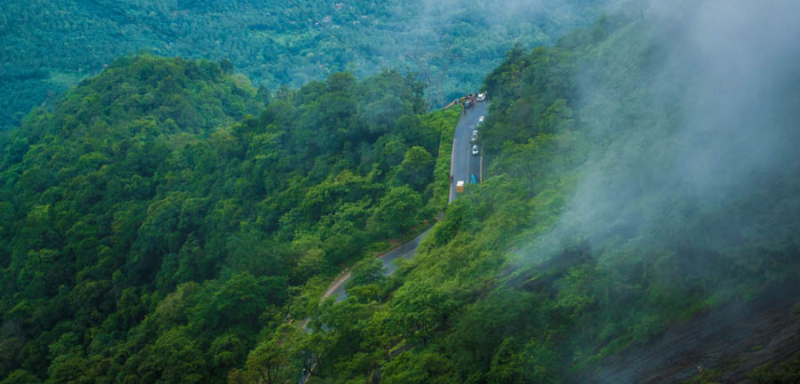
During the monsoon, Wayanad becomes a world layered in green upon green with tea estates, paddy fields, spice plantations, and dense forest all merging into one continuous landscape.
Rain softens the edges of everything. Hills disappear into fog. Roads glisten. Streams swell into fast-moving ribbons of water.
But Wayanad is not only natural beauty. It is also history.
The Edakkal Caves, with their ancient rock carvings believed to be over 6,000 years old, require a climb through wet stone and mist. Reaching them feels like stepping back into a time when humans first began to leave their mark on the landscape.
Final Reflection: India’s Most Honest Season
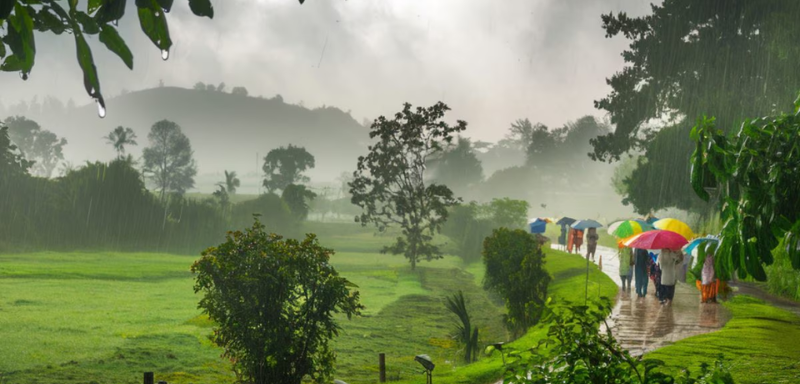
Monsoon is when India stops performing and starts revealing.
It strips away dust and distance, replacing them with immediacy, wet earth underfoot, mist on skin, and landscapes so vivid they feel almost unreal.
To travel during this season is not just to see India differently. It is to feel it differently.
And once you have seen it in monsoon, you may find every other version slightly less alive.