

Two giants, each with very different strengths. Here’s a clear and honest breakdown of pricing, flights, loyalty rewards, app experience, and customer support, so you can stop second-guessing and book with confidence.
So how do you decide which one actually works best for your trip? Whether you’re chasing budget-friendly flights across Asia or looking for the perfect stay in Europe, understanding where each platform excels can make all the difference. Let’s break it down.
Because when you’re planning a trip, the platform you choose isn’t just about convenience, it directly impacts how much you pay, the support you receive if something goes wrong, and whether your loyalty truly earns meaningful rewards. At first glance, these platforms may seem similar but in reality, they operate very differently.
Flights: one platform offers them, the other doesn’t

This is the starkest difference between the two. Booking.com has long been a hotel-first platform and, at time of writing, still doesn’t offer direct flight booking. For any trip requiring air travel, you’d need to hop to a separate tool like Google Flights or Skyscanner.
Trip.com, by contrast, is a full-service flight booking engine. It rivals Skyscanner in breadth of options, with added filters for stops, duration, and airline preference, plus it rewards you with Trip Coins on every flight booking. For multi-leg international trips, being able to bundle flights and hotels on a single platform is a genuine time (and money) saver.
Hotel inventory and pricing

Booking.com wins on sheer volume of listings, especially across Europe and North America. Its filtering system is exhaustive, you can sort by neighbourhood, property type, guest review score, breakfast inclusion, and dozens of other parameters. For power users planning a specific stay, it’s hard to beat.
Trip.com has the edge in Asia-Pacific. Its location filters go deeper for Asian cities, allowing searches by metro line, specific station, or proximity to a landmark, genuinely useful when navigating a city like Tokyo or Seoul. For hotels in Europe and the US, prices on both platforms tend to be comparable. In Asia, Trip.com’s rates are consistently sharper.
One notable gap: Trip.com doesn’t offer a best-price guarantee, while Booking.com does, they’ll match a cheaper rate found elsewhere, which can be useful if you prefer the familiarity of one platform but spot a better price on another.
Loyalty programs
| Feature | Trip.com (Trip Coins) | Booking.com (Genius) |
| Earn structure | Up to 5% back in coins on bookings | Flat discount at each Genius level |
| Spendable rewards | Yes, coins spend like cash | No, discounts only, no accumulated currency |
| Stackable offers | Yes, app coupons + coins + promos | No, Genius discount stands alone |
| Level 1 perk | Coins on every booking | 10% off select hotels |
| Higher-tier perks | Holiday vouchers, member sales | Room upgrades, late checkout, free breakfast |
Trip.com’s rewards feel more like an airline miles programme, you accumulate something tangible and spend it like currency on future bookings. Booking.com’s Genius programme is closer to a hotel membership card: you unlock a percentage off, but nothing rolls over or compounds. If you travel frequently, Trip.com’s stackable coupons and coin cashback tend to deliver more net value over time.
App experience
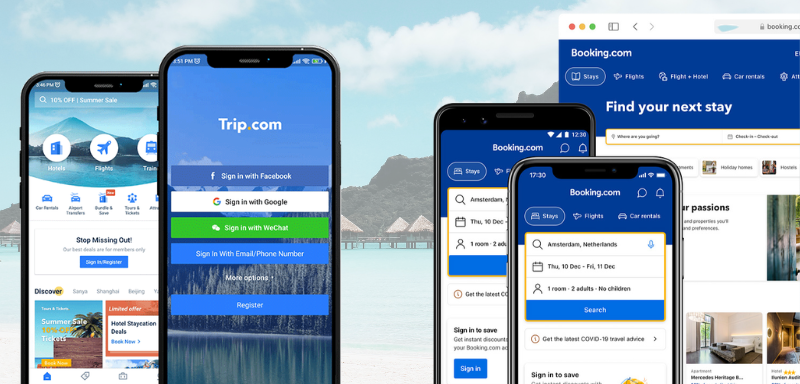
Both platforms are available on iOS and Android, but the experience differs noticeably. Trip.com’s app is praised for being lean and fast, it loads cleanly, handles bookings with minimal friction, and integrates well with device calendars and notifications. It feels designed for someone booking between layovers.
Booking.com’s app is more powerful, with live maps, saved preferences, travel guides, and seamless cross-device syncing. But it’s also heavier with more notifications, more urgency prompts (“only 1 room left!”), more filters to wade through. For first-time or occasional users, Trip.com’s cleaner flow wins. For frequent users who want full control, Booking.com’s depth has its place.
Customer support

This is where the gap is sharpest. Trip.com offers 24/7 live chat in multiple languages, and is consistently credited with fast resolution like flight issues, cancellations, and rebooking have reportedly been sorted in under 15 minutes via chat.
Booking.com, by contrast, frequently directs customers to “contact th the property directly” for any hotel-side issues. For flight-related problems, they don’t apply, since they don’t book flights. If something goes wrong mid-trip, Trip.com’s centralised support structure is a meaningful advantage.
Side-by-side summary
| Category | Trip.com | Booking.com |
| Flights | Yes, full booking engine | No |
| Hotel inventory (global) | Strong, especially Asia | Largest globally |
| Asia-Pacific pricing | Consistently cheaper | Comparable |
| Europe / North America | Competitive | Slight edge |
| Bundles (flight + hotel) | Yes | No |
| Loyalty rewards | Coins + stackable coupons | Genius discounts |
| User reviews | Good in Asia, limited elsewhere | Vast, verified, reliable |
| App simplicity | Cleaner, faster | Feature-rich, heavier |
| Customer support | 24/7 live chat, fast response | Often refers to property |
| Best price guarantee | No | Yes |
Bottom line: who should use what

→Booking flights anywhereTrip.com
→Hotels in Europe or North AmericaBooking.com
→Hotels in Asia-PacificTrip.com
→Flight + hotel bundlesTrip.com
→Reading verified hotel reviewsBooking.com
→Loyalty rewards with real valueTrip.com
→Support when things go wrong mid-tripTrip.com
→Widest hotel selection, any destinationBooking.com
The smartest move is to use both. Start on Trip.com to price out flights and bundles. Cross-check hotels on Booking.com, particularly if you’re heading to Europe and want to lean on Genius discounts or verified reviews. Neither platform is universally superior but if you’re only going to default to one, Trip.com now covers more of the travel journey end-to-end.